
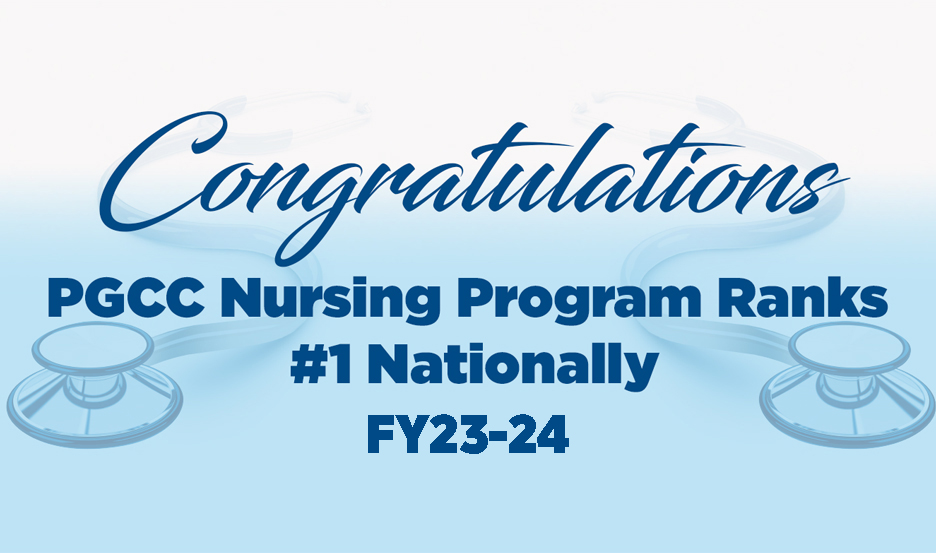
Explore Nursing at Prince George's Community College
History of Prince George's Community College Nursing
The nursing program at Prince George’s Community College was established in 1968. The nursing program, was approved by the Maryland Board of Nursing in 1969 and accredited by the National League for Nursing (NLN) , now the Accreditation Commission for education in nursing (ACEN), in 1976. The first class graduated 13 students. The program placed students in three clinical sites and employed two full time faculty members. The department of nursing established an LPN to RN Transmission Pathway in 1995, after successful completion of transition courses, students entered the second year of RN program. In 2010, a paramedic to RN Transmission Pathways was developed, after successful completion of the transition course, students entered the second year of the RN program. In summer 2012, the Department of Nursing moved from its original location in Lanham Hall to the new state-of- the-art Center for Health Studies (CHS) building. This move greatly expanded the program’s ability to achieve student learning outcomes using instructional technologies and choice learning strategies such as simulation, lab scenarios, skills lab practices and assessment, and tutoring.
In the late 1990’s the college, as well as the nursing program, began experiencing more minority student admission. Currently 90% of students are minorities. Students represent over 15 countries. The majority of students enrolled in the nursing program are considered nontraditional students. This means that they are adult learners, most of whom work part-time or full time, and support families in some way. Since the advent of the program, Prince George’s Community College has graduated over 6000 nurses who work in facilities throughout the United States and worldwide. The Nursing Program at Prince George’s Community College celebrated its 50th anniversary on May 18, 2018.
Mission
The Mission of the Prince George’s Community College (PGCC) Department of Nursing is to educate and transform the lives of our diverse population of nursing students to become caring, competent, and ethical professional nurses who will meet the healthcare needs of our community and who will develop a continued practice of learning to position themselves in the global community.
Philosophy
The Philosophy of the nursing program also reflects the beliefs and values of the faculty concerning the nature of the individual, health, nursing practice, nursing education, and learning. It states:
- We believe the client is a unique individual, possessing dignity and worth. Clients are complex beings with physiological and psychosocial needs, capable of change and growth within diverse and evolving physical, social, and cultural environments.
- We believe health is a dynamic process that encompasses one’s physical, mental, social, and spiritual well-being. Clients have the right to make choices regarding their healthcare. They may require assistance to meet self-care needs, to establish and attain health goals.
- We believe nursing is both an art and a science based on knowledge obtained from research and holistic, culturally competent practice. Nursing care should be accessible to the diverse community it serves in a unique, creative, and caring manner with an emphasis on addressing health risk reduction and healthcare disparities.
- We believe nursing reflects ethical and legal standards. The practice of nursing is an interprofessional collaboration that uses therapeutic communication and evidence-based practice to promote, maintain, and restore health with a focus on physiological and psychosocial integrity to clients across the lifespan.
- We believe the goal of nursing education is to prepare the graduate to become a safe, responsible, entry-level practitioner able to demonstrate effective clinical judgment in adapting care to the individual, guided by the National League for Nursing’s core values of caring, integrity, diversity, and excellence to obtain quality healthcare outcomes.
- We believe learning is an active, collaborative, life-long process in which the diverse learning styles of students are accommodated through a variety of teaching methodologies. Nursing students are adult learners who are accountable for their learning and engage in the learning process actively and through self-direction.
Nursing Program Outcomes
- Choose question
Facilities & Resources
The nursing department is located at the state-of-the-art Center for Health Studies building. The nursing department has two general nursing skills labs, four specialty nursing skills labs, two interdisciplinary simulation labs, and dedicated tutoring areas. The classrooms are equipped with Smart podiums and interactive instructional technology which enhance the learning experience of students.
The skills lab suites and simulation rooms contain high fidelity simulation manikins, critical care equipment, and medication administration capabilities. The students are provided with supplies and medical equipment to meet the learning outcomes of the nursing courses, and provides a learning environment that coincides with current practice and clinical setting.
Vivian Kuawogai
Contact Us
Vivian Kuawogai
Department Chair and Professor
Health, Wellness, and Hospitality Division
Prince George's Community College
Office Telephone: 301-546-0734
Email: kuawogvp@pgcc.edu
Prince George’s Community College
Center for Health Studies, Room 1402
301 Largo Road
Largo, MD 20785